Sunday, February 26, 2017

Square Melons & Coming Up with New Ideas


If you've ever had to cut a melon, you will know it is not the easiest food to slice up for a snack.

Innovators have come up with a simple solution. They found a way to grow a square melon. 
Design thinking - creative strategies designers use to consider issues and solve problems while creating new ideas  

Solutions to problems like these seem so simple, yet are so effective.  Getting into the mind of people who design new things could be useful to us as students learning about science and engineering.  

Professors at Yale University Barry Nalebuff and Ian Ayres believe that taking problems and flipping them 180 degrees to the opposite of reality is one way to come up with radical new ideas that lead to innovation today's world. 


Over half of the process of making new things is in the coming-up-with-ideas phase.  If we aren't feeling out the needs of the people who will use a product and don't understand the problem we can't think of useful and innovative solutions.  

In class we will begin our unit on design by discussing how teams of people work together to come up with new ideas that people want and need.  Students will be involved in an activity called the "Bad Idea Factory."  In this activity they will be asked to come up with as many bad ideas as they can in a set amount of time.  Through this activity we discuss what it means to come up with new ideas and how we can "ideate" more effectively in groups.

Thanks to Mr. Farren for sharing the Nalebuff, Ayers article

Tuesday, February 14, 2017

Chemical Science Design Project


You and your group are in charge of using chemicals to make a self-warming/cooling device for people to use. You can design any type of device, but your design must use the chemicals to heat or cool it in safe way. Your device can be for any situation where it might be useful: everyday use, military, skiing, hiking, fishing, boating, etc.

You and your group must design (and possibly construct) a device that uses a chemical process to warm or cool itself.  Then, you must present your design in digital format for others to give feedback.

The overall presentation must include:
  1. The device:
    • model - could be a drawing, poster, video, or digital model.  
    • your model should include labels and measurements 
  2. A written explanation/advertisement that should include: 
    • A slogan or name for your device
    • Who will use your device? 
    • How your device works (include chemical reaction)

You will individually reflect on some of the following questions:
  • What problem does your device solve? 
  • How did you choose the chemicals to be used? 
  • What changes were made to your design when making the solution?
  • What problems might still need to be worked out before a device like this might actually be used? 
  • Which habits of learning did this project challenge the most for you and why?
  • How did your ideas and effort lead to the final product?
Project Resources:
Project Rubric - How you will be assessed.  Provides feedback on your use of the design processes.
Endothermic & Exothermic Info - Slideshow with some examples of these two types of reaction.
End of Project Reflection - Sample of what you will write at the end of the project.
*Special Thanks to Mr. Jason Booker for help in designing this project NGSS MS-PS1-6

Monday, January 16, 2017

Unit 4: Reaction Action - Chemical Changes

Unit Information:


BOOM!  SIZZLE!  POP!

Science is a study of change.  Many people might agree that some of the coolest changes are caused by chemicals interacting with each other.

You may not think about it but, chemical reactions are happening all the time all around you---even INSIDE of you.  During this unit we will explore chemical reactions, what they are, how they work and how they keep the world going.  


Find other chemical reaction gifs like this check out reddit.com

Friday, November 25, 2016

Thermal Energy Experiment


In this project each student will design and carry out her or his own experiment with following goal in mind:
Plan an investigation to learn about the relationships between energy moving from one place to another, the type of matter, the mass, and the change in average kinetic energy of the particles. Average kinetic energy should be measured by temperature in Celsius. (NGSS MS-PS3-4)
Project guides and resources (all shared on Classroom for students):

Lab Report Template
Lab Report Example - Mixing Colors Experiment
Experiment Assessment Rubric - Five Areas of Feedback Graded on a 1-7 Scale (Marked in Veracross)

Thursday, November 10, 2016

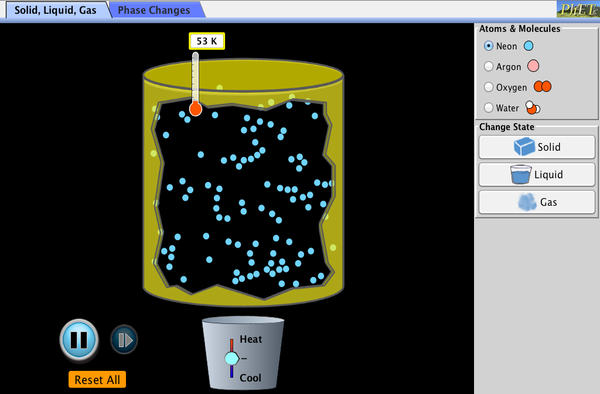
SIMULATION: Sold, Liquid, Gas

States of Matter: Basics
Click to Run

After clicking above, you may need to Open your Mac's "Security & Privacy" settings and "Open anyway." (See screenshots below)  You also might need to download Java.