Unit Concepts & Resources
Unit Vocabulary
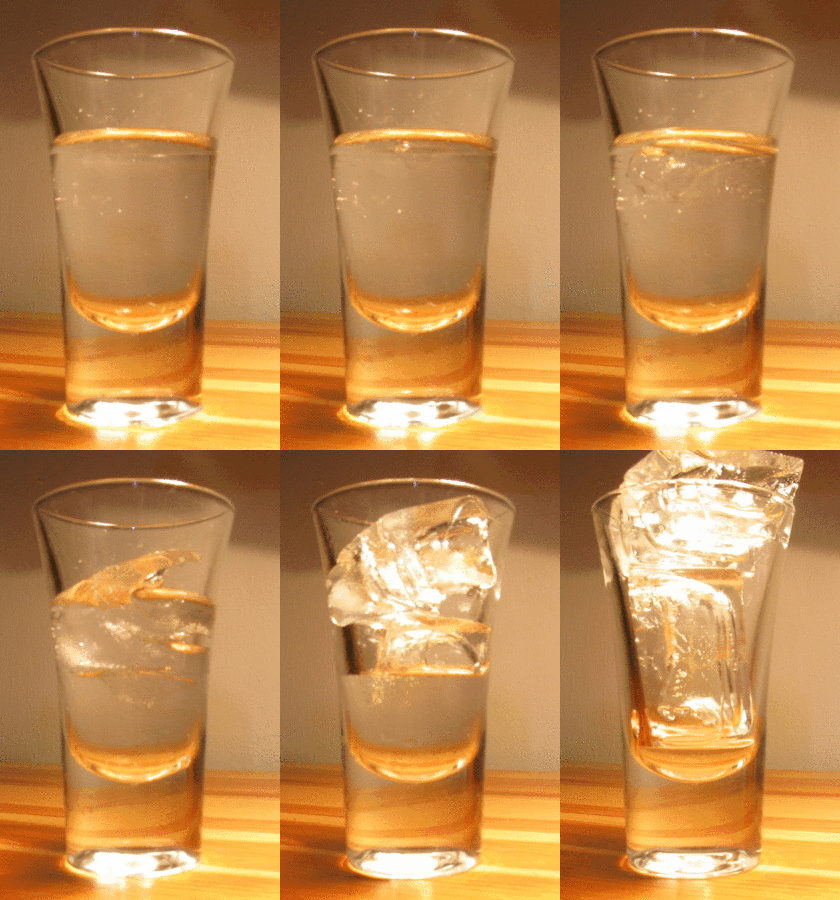
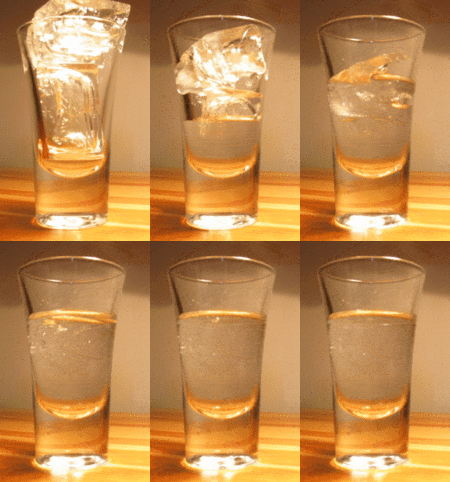
Which one of these animations make the most sense to you?
Water freezing back into a cube does not fit into our idea of reality. This illustrates the idea of entropy. Entropy is a measure of the random activity in a system. A scientific law is devoted to this stating that the general tendency of the universe is to move from order and structure to lack of order, lack of structure. Or, in a system entropy has a tendency to increase.
Your room at home does not clean itself up without the energy someone tidying up your space. In the same way, a 1000 piece jigsaw puzzle does not put itself back together without a considerable amount of time and attention.
In his Ted Talk David Christian tells The history of our world in 18 minutes. He suggests that our world is full of complexity. We don't have to look far to agree with him. In our own bodies exist systems with great complexity with cells full of tiny organelles, fully functioning body systems, and DNA providing codes for it all. What's more, our world has produced civilizations with elaborate communication and transportation systems. David Christian asks: In a universe ruled by laws of increasing entropy, how is it possible to generate the sort of complexity that exists in our world today?
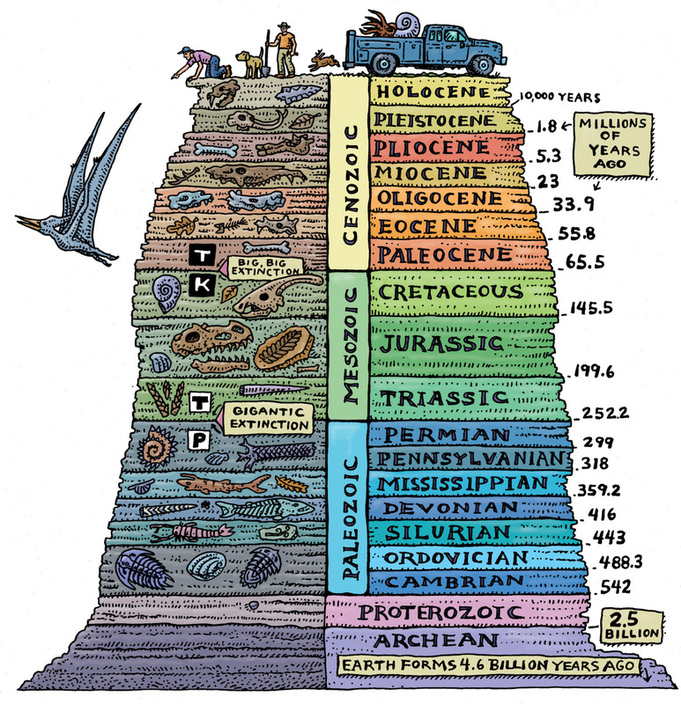
In our next unit, we will look into this idea. We'll journey back into time to improve our idea of the geologic timescale. We'll look at the fossil record that has been used to build our concept of the past. We'll look into how populations have changed over time and the many factors that cause that change. We will hopefully come away with a better idea the life that came before us and how it can inform our ever complexifying world before us.
Showing posts with label unit goals. Show all posts
Monday, November 6, 2017
Sunday, April 23, 2017
Unit 6: Earth & Space
Unit Goals & Resources
Unit 6 Vocabulary
Pale. Blue. Dot. It's a picture of your home.
Can you see your home below?
[Click forward arrow at the bottom of the image]
Unit 6 Vocabulary
Pale. Blue. Dot. It's a picture of your home.
Can you see your home below?
[Click forward arrow at the bottom of the image]
If the Voyager I Space probe was on Snapchat, it's the shot it would have posted. Voyager I, NASA's camera mounted hunk of metal hurling through space took the photo just before exiting our solar system. The photo was taken from a record distance of about 6 billion kilometers (3.7 billion miles) from Earth. Karl Sagan, a famous astronomer and author asked NASA to control the space probe to turn around and take the photo before leaving our system. Hear his famous reflection of the picture in this video:
This kind of thing gives us perspective. In this unit we will explore not just WHERE we are in space, but also WHEN we are in time and how Earth's forces have changed our planet over time.
Friday, March 17, 2017
Unit 5: Forces of Change
Unit 5 Goals & Resources
Unit 5 Vocabulary
In the first unit this year we asked ourselves the question "what is science?" Hopefully through the course of the year your idea of science has expanded.
Sir Isaac Newton expanded our view of the world tremendously during his lifetime. He was able to do this by taking ideas of earlier scientists (people like Copernicus, Kepler, and Galileo) and make connections with his own observations of the universe.
BBC iWonder - Isaac Newton
Unit 5 Vocabulary
In the first unit this year we asked ourselves the question "what is science?" Hopefully through the course of the year your idea of science has expanded.
Sir Isaac Newton expanded our view of the world tremendously during his lifetime. He was able to do this by taking ideas of earlier scientists (people like Copernicus, Kepler, and Galileo) and make connections with his own observations of the universe.
Newton, most likely did not set out to be the most influential scientist of his time. Yet, his unique ideas have become common laws that we still apply today in everything from space travel to outsmarting the other team by making the best football play possible.
As you explore energy and forces in our last unit, we will not only look for ways to understand these ideas, but also how to use our ideas to impact the world.
Keep an open mind, you never know how your unique experiences and ideas, like Isaac Newton, will impact the world in both small and very big ways.
BBC iWonder - Isaac Newton
Monday, January 16, 2017
Unit 4: Reaction Action - Chemical Changes
Unit Information:
BOOM! SIZZLE! POP!
Science is a study of change. Many people might agree that some of the coolest changes are caused by chemicals interacting with each other.
You may not think about it but, chemical reactions are happening all the time all around you---even INSIDE of you. During this unit we will explore chemical reactions, what they are, how they work and how they keep the world going.
Find other chemical reaction gifs like this check out reddit.com
Saturday, November 5, 2016
Unit 3: Messin' More With Matter - Physical Changes
Unit Information:
Unit 3 Goals & Resources
Unit 3 Vocabulary Help (Quizlet Set)
Shape shifting into multiple forms, growing in size in the cold, dissolving many things on the planet just by touching it, and defying the pull of gravity.
It has been the source of transportation for centuries, and wars have started over it; yet, you can find it in your house and it even makes up most of you.
Water is pretty amazing stuff! Did you know it's one of the only substances that is less dense in its solid state than it is in its liquid state? This video explains this in depth:
Our next unit is about the changes that happen to matter when thermal energy is added or taken away. Often we will use water as an example because it is the only substance on Earth that naturally occurs in a solid, liquid, and gas state.
Who would have thought that something so ordinary was so unique!?!
Unit 3 Goals & Resources
Unit 3 Vocabulary Help (Quizlet Set)
Shape shifting into multiple forms, growing in size in the cold, dissolving many things on the planet just by touching it, and defying the pull of gravity.
It has been the source of transportation for centuries, and wars have started over it; yet, you can find it in your house and it even makes up most of you.
The substance is known by some as H2O, but most people just call it---water.
Water is pretty amazing stuff! Did you know it's one of the only substances that is less dense in its solid state than it is in its liquid state? This video explains this in depth:
Who would have thought that something so ordinary was so unique!?!
Thursday, September 29, 2016
Unit 2: What's the Matter?
Unit Information:
Unit 2 Goals & Resources
Unit 2 Vocabulary Help
Why is it so important to understand the very, very small things in our world?
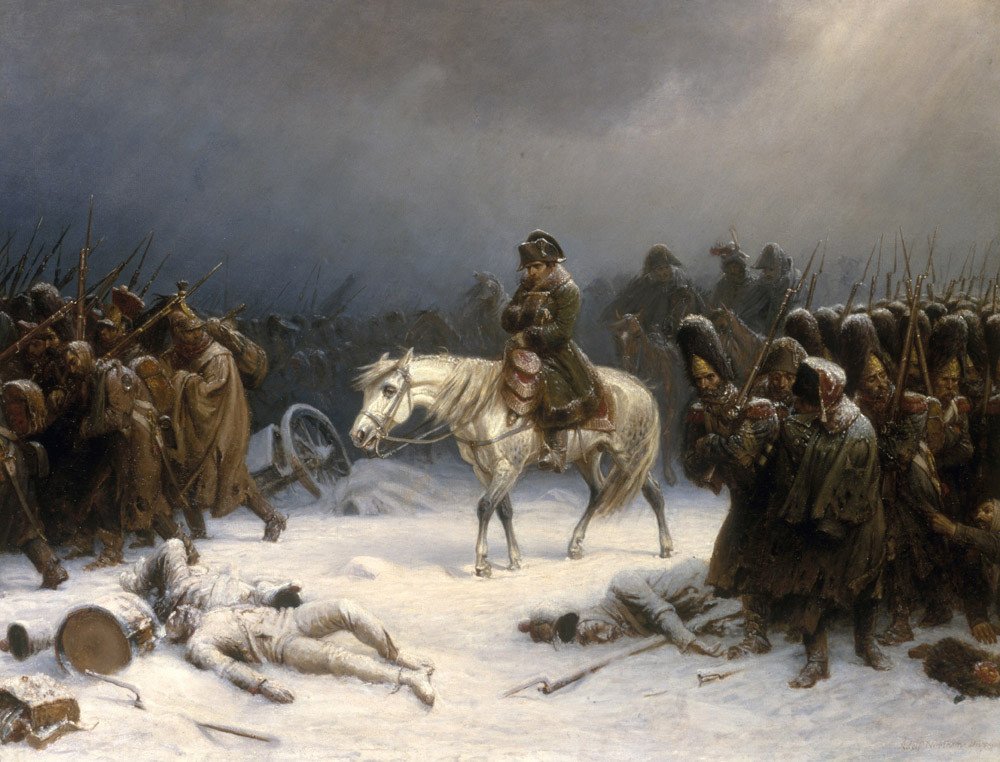
In the book Napoleon's Buttons: 17 Molecules That Changed History the author explains how Napoleon Bonaparte, the French Emperor, was not able to move his army any further against the Russian army because of something very small---a button. As the story goes: Napoleon's army had coats with buttons made from a metal called tin. One of the properties of tin is that it breaks down when it becomes cold.
The author explains that during the cold Russian winter, the buttons on the French soldier's coats broke, opening them up to the cold. Besides causing sickness, fighting without buttons might be difficult.
We do know for sure that during the winter of 1812 the French Grande Army lost thousands of men and were forced to retreat. From this point, France was never able to realize its vision of ruling over a huge empire and Russia would continue to remain free of foreign rule.
In this example of Napoleon's Army we can see that the understanding the properties of something as simple as the atoms in tin can make a huge difference in history.
Chemistry is the study of chemical elements (like tin, gold, helium, uranium, oxygen, etc.) and compounds (like water, sugar, carbon dioxide) and how matter like this changes.
One of the goals of this unit is to explore what matter is. You will be given a chance in this unit to understand how our world works by analyzing the very small.
If the answers to many problems in our world are found in the very small, who knows where research and understanding atoms and molecules could eventually lead us?
Unit 2 Goals & Resources
Unit 2 Vocabulary Help
Why is it so important to understand the very, very small things in our world?
In the book Napoleon's Buttons: 17 Molecules That Changed History the author explains how Napoleon Bonaparte, the French Emperor, was not able to move his army any further against the Russian army because of something very small---a button. As the story goes: Napoleon's army had coats with buttons made from a metal called tin. One of the properties of tin is that it breaks down when it becomes cold.
![]() |
| Napoleon and his Grande Armée, Retreating from Moscow |
![]() |
| Tin button |
We do know for sure that during the winter of 1812 the French Grande Army lost thousands of men and were forced to retreat. From this point, France was never able to realize its vision of ruling over a huge empire and Russia would continue to remain free of foreign rule.
In this example of Napoleon's Army we can see that the understanding the properties of something as simple as the atoms in tin can make a huge difference in history.
Chemistry is the study of chemical elements (like tin, gold, helium, uranium, oxygen, etc.) and compounds (like water, sugar, carbon dioxide) and how matter like this changes.
One of the goals of this unit is to explore what matter is. You will be given a chance in this unit to understand how our world works by analyzing the very small.
If the answers to many problems in our world are found in the very small, who knows where research and understanding atoms and molecules could eventually lead us?
Monday, August 22, 2016
Unit 1: Science is...
Unit Information
Unit 1 Goals and Resources [what is this?]
Unit 1 Vocabulary [what is this?]
Neil deGrasse Tyson, a famous astrophysicist, says we have been scientists since birth; and that science is in our DNA. But WHAT EXACTLY does it mean to be a scientist? What's more, WHAT IS SCIENCE? We will explore these two main ideas in this short introductory unit to Science 6 at AISB!
Unit 1 Goals and Resources [what is this?]
Unit 1 Vocabulary [what is this?]
Neil deGrasse Tyson, a famous astrophysicist, says we have been scientists since birth; and that science is in our DNA. But WHAT EXACTLY does it mean to be a scientist? What's more, WHAT IS SCIENCE? We will explore these two main ideas in this short introductory unit to Science 6 at AISB!
Thursday, May 12, 2016
Unit 7: Sparking Change at AISB
Unit Goals & Resources
Vocabulary
Pale Blue Dot. It's a picture of your home.
Can you see your home in the photo below?
[Click forward arrow at the bottom for some help]
If the Voyager I Space probe was on Snapchat, it's the pic it would have sent you some years back. Voyager I, NASA's camera mounted hunk of metal hurling through space took the photo just before exiting our solar system. The photo was taken from a record distance of about 6 billion kilometers (3.7 billion miles) from Earth. Karl Sagan, a famous astronomer and author asked NASA to control the space probe to turn around and take the photo before leaving our system. Hear his famous reflection of the picture in this video.
From all the billions of kilometers away we see our "Spacecraft Earth," the tiny planet with a built-in life support system that you were born into and that your children will more than likely call home.
In one way or another, the life support system on Spacecraft Earth provides the air you breathe, the food you eat, the water you drink. It sustains temperatures and pressures that your body can handle.
Yet, each day we use the atmosphere as a landfill for our waste. Factories, transportation, deforestation as well as our personal need to consume resources, all of these things are a danger to the life support system on planet Earth.
Scientists have been collecting data that shows a change in our planet's temperature, weather patterns, and sea level.
In this next unit we will look at this data and ask the questions:
Vocabulary
Pale Blue Dot. It's a picture of your home.
Can you see your home in the photo below?
[Click forward arrow at the bottom for some help]
If the Voyager I Space probe was on Snapchat, it's the pic it would have sent you some years back. Voyager I, NASA's camera mounted hunk of metal hurling through space took the photo just before exiting our solar system. The photo was taken from a record distance of about 6 billion kilometers (3.7 billion miles) from Earth. Karl Sagan, a famous astronomer and author asked NASA to control the space probe to turn around and take the photo before leaving our system. Hear his famous reflection of the picture in this video.
From all the billions of kilometers away we see our "Spacecraft Earth," the tiny planet with a built-in life support system that you were born into and that your children will more than likely call home.
In one way or another, the life support system on Spacecraft Earth provides the air you breathe, the food you eat, the water you drink. It sustains temperatures and pressures that your body can handle.
Yet, each day we use the atmosphere as a landfill for our waste. Factories, transportation, deforestation as well as our personal need to consume resources, all of these things are a danger to the life support system on planet Earth.
Scientists have been collecting data that shows a change in our planet's temperature, weather patterns, and sea level.
In this next unit we will look at this data and ask the questions:
- How is the Earth's climate changing?
- How can we as global citizens limit our impact on the Earth to ensure the best home for future generations?
Special thanks to Mr. Farren for the links to Pale Blue Dot and Blue Man Group and also for the idea of "Spaceship Earth."
Friday, February 5, 2016
Unit 4: Rocks, don't take them for granite - Geologic Time
Unit 4 Goals & Resources
Unit 4 Vocabulary (Student Created Glossary of Terms)
Have humans permanently changed the planet?
Unit 4 Vocabulary (Student Created Glossary of Terms)
Have humans permanently changed the planet?
This question has started a debate of *when* in time we are living---meaning, where on the geologic time scale do we find ourselves right now?
If you have not heard about this mother of all timelines, the geologic time scale is divided into units based on events which took place in Earth's 4.6 billion-year-old history. Boundaries in the timeline are decided by major changes in rock layers.
Many people agree that we are currently in the Holocene Epoch, in the Quaternary Period, in the Cenozoic Era in the Phanerozoic Eon. The Holocene Epoch began right at the end of the last ice age over 11,000 years ago. It was during this time we can see major changes in rock data.
However, according to some scientists at the International Union of Geological Sciences we have now left the Holocene epoch and now are in a NEW epoch called the Anthropocene. Anthropo meaning "man" and cene meaning "new."
Scientists say that humans have made such an impact on our planet that we can see it in the soil. For example, if we look at rock layers worldwide, we would find a change in the radioactivity in the soil in 1964. It was during this time when nuclear weapons were being tested. Some scientists use this and many other indicators as evidence that we have permanently changed the planet in such a way that we have brought about a new epoch.
In this upcoming unit we will be looking at rocks for evidence to the past. We will be asking questions like how does the Earth change over time and how can rock types and rock layers be clues to the past? We will look at landforms and study how erosion and plate boundaries have changed our earth over time.
Hopefully by the end of this unit, we will gain a better understanding of not just where we are in the universe, but WHEN we are in time.
Read more about the Anothropocene on Science News for Students
Sunday, October 13, 2013
Student Unit Goals
You are expected to understand each unit goal by the end of this unit.
Students have worked hard to create material that can be useful to your understanding of each unit goal. Please take time to visit this document when you finished your project and add anything that was helpful to your understanding of the unit goal or driving questions.
The doc will be used by everyone in the grade.
It will also be added to your main unit blog post (see pic below - it is the one you see by clicking the unit tab).
Students have worked hard to create material that can be useful to your understanding of each unit goal. Please take time to visit this document when you finished your project and add anything that was helpful to your understanding of the unit goal or driving questions.
The doc will be used by everyone in the grade.
It will also be added to your main unit blog post (see pic below - it is the one you see by clicking the unit tab).
![]() |
| Now you can access student unit goals from the main unit blog post |
Wednesday, May 29, 2013
Unit Goals - Dates for Feedback
If you want feedback on your unit goals 1-9, you must complete and turn in on during class on the days listed below.
If you do not make these due dates, please see me outside of class time for feedback on any unit goals.
Weds 29 - Unit Goals 1 & 2
Thurs 30 - Unit Goals 3, 4 & 5
Tues 4 - Unit Goals 6 & 7
Weds 5 - Unit Goals 8 & 9
TEST THURSDAY
If you do not make these due dates, please see me outside of class time for feedback on any unit goals.
Weds 29 - Unit Goals 1 & 2
Thurs 30 - Unit Goals 3, 4 & 5
Tues 4 - Unit Goals 6 & 7
Weds 5 - Unit Goals 8 & 9
TEST THURSDAY
Subscribe to:
Posts (Atom)

.jpg)