Thursday, May 12, 2016

Unit 7: Sparking Change at AISB

Unit Goals & Resources
Vocabulary

Pale Blue Dot.  It's a picture of your home.

Can you see your home in the photo below?
[Click forward arrow at the bottom for some help]

If the Voyager I Space probe was on Snapchat, it's the pic it would have sent you some years back.  Voyager I, NASA's camera mounted hunk of metal hurling through space took the photo just before exiting our solar system.  The photo was taken from a record distance of about 6 billion kilometers (3.7 billion miles) from Earth.  Karl Sagan, a famous astronomer and author asked NASA to control the space probe to turn around and take the photo before leaving our system.  Hear his famous reflection of the picture in this video.


From all the billions of kilometers away we see our "Spacecraft Earth," the tiny planet with a built-in life support system that you were born into and that your children will more than likely call home.

In one way or another, the life support system on Spacecraft Earth provides the air you breathe, the food you eat, the water you drink.  It sustains temperatures and pressures that your body can handle.

Yet, each day we use the atmosphere as a landfill for our waste.  Factories, transportation, deforestation as well as our personal need to consume resources, all of these things are a danger to the life support system on planet Earth.

Scientists have been collecting data that shows a change in our planet's temperature, weather patterns,  and sea level.

In this next unit we will look at this data and ask the questions:
  • How is the Earth's climate changing?
  • How can we as global citizens limit our impact on the Earth to ensure the best home for future generations?
The main work of this unit will be designing our very own solutions that could lead to improving our school's impact on our home, our life-supporting spaceship---the Pale Blue Dot.


Special thanks to Mr. Farren for the links to Pale Blue Dot and Blue Man Group and also for the idea of "Spaceship Earth."

Monday, May 2, 2016

Newton's Law Project


Your task:


Work by yourself or with a partner to design an experiment to explore Newton’s 1st or 2nd Law.  You must identify independent and dependent variables and controls, what tools are needed to do the gathering, how measurements will be recorded, and how many data are needed to support a your hypothesis.  At the end of your experiment you must analyze your data, and reflect on your procedure and results.  


How you will demonstrate your learning:

  • Each partner will be interviewed separately about the design of the experiment.
  • Display data table and/or graph as well as photos and/or video on class slideshow to share experiment with classmates.
  • Each person will submit a Conclusion & Reflection Form.

Monday, February 29, 2016

Earth Science Project

Students are exploring a variety of topics dealing with Earth Science.  They will ask questions related to their topic, create a thesis statement, research from a variety of sources, and create models of their learning.

Students will present their work to their classmates to share their learning.


Project resources:


Saturday, February 13, 2016

Clash of Clans: Battle Through Geologic Time

In order to learn about Earth science topics and have a little fun, we will compete against each other in a game called:


How to Play:

Work together with your clan to learn each of the unit learning goals.  Show what you know on a short quiz.  Quizzes are ungraded assessments of your understanding of the the main concepts of the unit.

Clans & Score Sheet

The winning clan will get a prize and be featured in a picture that will be posted for all in the MS to see.


Friday, February 5, 2016

Unit 4: Rocks, don't take them for granite - Geologic Time


This question has started a debate of *when* in time we are living---meaning, where on the geologic time scale do we find ourselves right now?

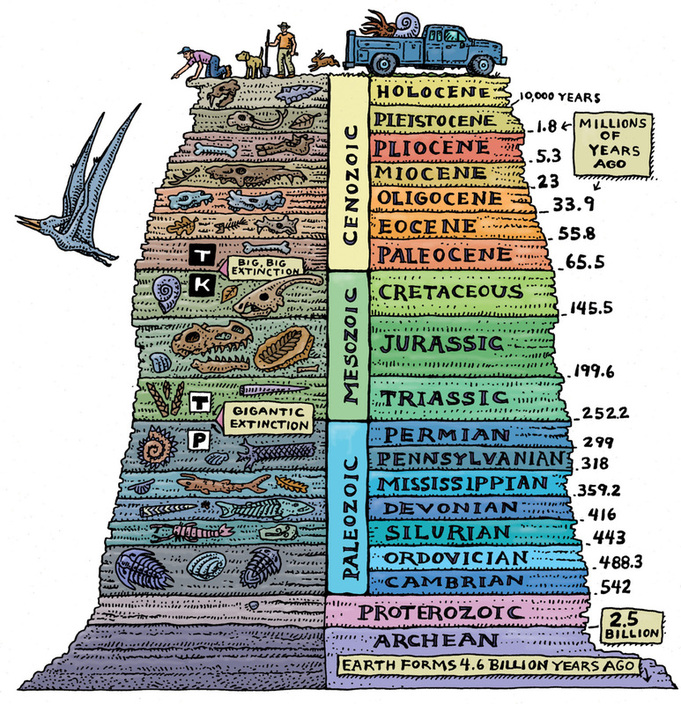
The Basic Geologic Time Scale Based on Rock Layers

If you have not heard about this mother of all timelines, the geologic time scale is divided into units based on events which took place in Earth's 4.6 billion-year-old history.  Boundaries in the timeline are decided by major changes in rock layers.

Many people agree that we are currently in the Holocene Epoch, in the Quaternary Period, in the Cenozoic Era in the Phanerozoic Eon.  The Holocene Epoch began right at the end of the last ice age over 11,000 years ago.  It was during this time we can see major changes in rock data. 

However, according to some scientists at the International Union of Geological Sciences we have now left the Holocene epoch and now are in a NEW epoch called the Anthropocene.  Anthropo meaning "man" and cene meaning "new."


Scientists say that humans have made such an impact on our planet that we can see it in the soil.  For example, if we look at rock layers worldwide, we would find a change in the radioactivity in the soil in 1964.  It was during this time when nuclear weapons were being tested.  Some scientists use this and many other indicators as evidence that we have permanently changed the planet in such a way that we have brought about a new epoch.

In this upcoming unit we will be looking at rocks for evidence to the past.  We will be asking questions like how does the Earth change over time and how can rock types and rock layers be clues to the past?  We will look at landforms and study how erosion and plate boundaries have changed our earth over time.  

Hopefully by the end of this unit, we will gain a better understanding of not just where we are in the universe, but WHEN we are in time.

Read more about the Anothropocene on Science News for Students