Monday, February 29, 2016

Earth Science Project

Students are exploring a variety of topics dealing with Earth Science.  They will ask questions related to their topic, create a thesis statement, research from a variety of sources, and create models of their learning.

Students will present their work to their classmates to share their learning.


Project resources:


Saturday, February 13, 2016

Clash of Clans: Battle Through Geologic Time

In order to learn about Earth science topics and have a little fun, we will compete against each other in a game called:


How to Play:

Work together with your clan to learn each of the unit learning goals.  Show what you know on a short quiz.  Quizzes are ungraded assessments of your understanding of the the main concepts of the unit.

Clans & Score Sheet

The winning clan will get a prize and be featured in a picture that will be posted for all in the MS to see.


Friday, February 5, 2016

Unit 4: Rocks, don't take them for granite - Geologic Time


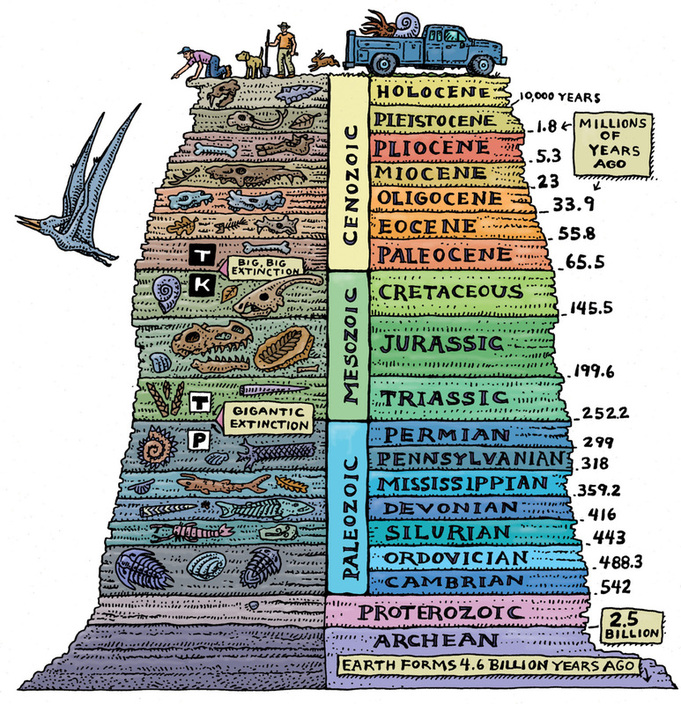
This question has started a debate of *when* in time we are living---meaning, where on the geologic time scale do we find ourselves right now?

The Basic Geologic Time Scale Based on Rock Layers

If you have not heard about this mother of all timelines, the geologic time scale is divided into units based on events which took place in Earth's 4.6 billion-year-old history.  Boundaries in the timeline are decided by major changes in rock layers.

Many people agree that we are currently in the Holocene Epoch, in the Quaternary Period, in the Cenozoic Era in the Phanerozoic Eon.  The Holocene Epoch began right at the end of the last ice age over 11,000 years ago.  It was during this time we can see major changes in rock data. 

However, according to some scientists at the International Union of Geological Sciences we have now left the Holocene epoch and now are in a NEW epoch called the Anthropocene.  Anthropo meaning "man" and cene meaning "new."


Scientists say that humans have made such an impact on our planet that we can see it in the soil.  For example, if we look at rock layers worldwide, we would find a change in the radioactivity in the soil in 1964.  It was during this time when nuclear weapons were being tested.  Some scientists use this and many other indicators as evidence that we have permanently changed the planet in such a way that we have brought about a new epoch.

In this upcoming unit we will be looking at rocks for evidence to the past.  We will be asking questions like how does the Earth change over time and how can rock types and rock layers be clues to the past?  We will look at landforms and study how erosion and plate boundaries have changed our earth over time.  

Hopefully by the end of this unit, we will gain a better understanding of not just where we are in the universe, but WHEN we are in time.

Read more about the Anothropocene on Science News for Students


Monday, January 25, 2016

Pumping Up Your Science Language Usage

Just as a bodybuilder has a plan to pump up his or her body that takes extra time and effort, you can develop your language to communicate more effectively in writing. Use the last part of your lab report to consider how you are using language based on your English Language level.


In the following three sections below you can find some language goals that Ms. Birzu helped to develop for our Lab Report project. Find your EAL Level. If you are a native English speaker then your level is "Advanced." Consider how you are using language to communicate your thoughts on your findings.

Language Target 1:

We can describe the changes in particle motion, temperature or state of a substance orally or in writing using topic-related science vocabulary to teach others how thermal energy affects the speed of particles in a substance
Describe the changes in particle motion, temperature or state of a substance
Beginner (Levels 1-2)
Intermediate (Levels 3-4)
Advanced (Levels 5-6/Native)
The particles move fast in hot water. They move slowly in cool water.


particles, substance, thermal energy, move, how much water/heat, temperature, warm, cold, experiment, cup, water
In the water with the highest temperature, the particles move faster, but in water with less thermal energy, they move more slowly.

remove, add, substance, matter, temperature, did this experiment, evaporates, liquid
When a substance is heated, the motion of the particles increases as the particles become more energetic. If it is cooled, the motion of the particles decreases as they lose energy.

increase, decrease, motion, amount of heat, affect, conducted this experiment, beaker, evaporates

Language Target 2:
We can compare and contrast the changes in substances when thermal energy is added or removed in writing using comparative and superlative adjectives, commonly used verbs, linking words/phrases, and topic-specific vocabulary to look for patterns in the data.
Compare and Contrast the changes in substances when thermal energy is added or removed
Beginner (Levels 1-2)
Intermediate (Levels 3-4)
Advanced (Levels 5-6/Native)
The particles in the hot water moved faster than the particles in the coldest water because they …....


faster than, hotter, the coldest
One similarity/difference between the speed of particles in the hottest water and the speed of particles in the warmest water was ....

A difference/similarity between the mixing speeds of particles in the warmest water and the coldest water was….

but, different from, however, in contrast, compared to, whereas, similarly, for example
The speed of particles in the hottest water and the speed of particles in the cold water were similar/different  because ......

Whereas the speed of particles in the hottest water increased , the speed of particles in the coldest water decreased.

differs from, alternatively, in contrast, whereas, on the one hand/on the other hand, for instance


Language Target 3: 
We can analyze the effects of adding or removing thermal energy in writing using cause and effect sentences in order to teach others about the impact of thermal energy on substances.
Analyze the effects using cause and effect sentences
Beginner (Levels 1-2)
Intermediate (Levels 3-4)
Advanced (Levels 5-6/Native)
…., so….. .
The cause was…... and the effect was….
Because…….,.....

The color in the cup (beaker) with the hot water mixed fast because the particles move faster in hot water than in cold water.


because (of), so

That was a result of….
Because of.., .. . Therefore,... Finally,...

When I put the colored dye in the beaker of hot water, the colored dye mixed/spread faster than in the beaker of cold water. That was a result of adding heat energy.


because (the...), so, thus, as a result,
The.....had a significant influence on…
____ was a result of…...
The change resulted in…

When I added the food coloring in beaker of hot water, it was obvious that adding thermal energy had a significant influence on the speed at which particles moved in that substance. The food coloring mixed/spread throughout the water faster than in the beaker of cold water. Also, the molecules were a little farther apart in hot water.

since, as a result of, for the purpose of, due to, as a consequence, therefore, in that case, accordingly,


Wednesday, January 20, 2016

Experiment Video Guide


Your experiment video is the place to show off your experiment to others.  The video should be a summary of your experiment that includes the following elements:

  • Your variables - You can do this how you would like---use your testable question, your hypothesis or just explain your variables individually.  
  • Your data - You do not need to include all your data, just the most important.  Remember, data is best presented in a visual form.  This could be graph, text on the screen or note cards with data written on them.  
  • Your conclusion - What was learned from your experiment?  You could answer your testable question, explain your hypothesis in relation to your data, or summarize a scientific concept or idea that was proven or learned by the experiment.
Your video does not need to have motion.  Feel free to create a photo slideshow in video form.  Also feel free to use voiceovers, speed up time, slow down time, and edit to the most important parts of your experiment.  The video does not need to be long!

All videos must be able to be uploaded to your a YouTube account (unlisted or public).  The school provides you with a YouTube account that you are free to use.  Programs like iMovie or YouTube Editor are good places to create your video.  

We will watch experiments and vote on our favorites in the class, then in the grade.  Winning videos will be on the TV Screens around our school.