Saturday, November 5, 2016

Unit 3: Messin' More With Matter - Physical Changes

Unit Information:
Unit 3 Goals & Resources
Unit 3 Vocabulary Help (Quizlet Set)

Shape shifting into multiple forms, growing in size in the cold, dissolving many things on the planet just by touching it, and defying the pull of gravity.

It has been the source of transportation for centuries, and wars have started over it; yet, you can find it in your house and it even makes up most of you.


The substance is known by some as H2O, but most people just call it---water.


Water is pretty amazing stuff!  Did you know it's one of the only substances that is less dense in its solid state than it is in its liquid state?   This video explains this in depth:


Our next unit is about the changes that happen to matter when thermal energy is added or taken away.  Often we will use water as an example because it is the only substance on Earth that naturally occurs in a solid, liquid, and gas state.

Who would have thought that something so ordinary was so unique!?!

Thursday, September 29, 2016

Unit 2: What's the Matter?

Unit Information:
Unit 2 Goals & Resources
Unit 2 Vocabulary Help

Why is it so important to understand the very, very small things in our world?

In the book Napoleon's Buttons: 17 Molecules That Changed History the author explains how Napoleon Bonaparte, the French Emperor, was not able to move his army any further against the Russian army because of something very small---a button.  As the story goes: Napoleon's army had coats with buttons made from a metal called tin.  One of the properties of tin is that it breaks down when it becomes cold.
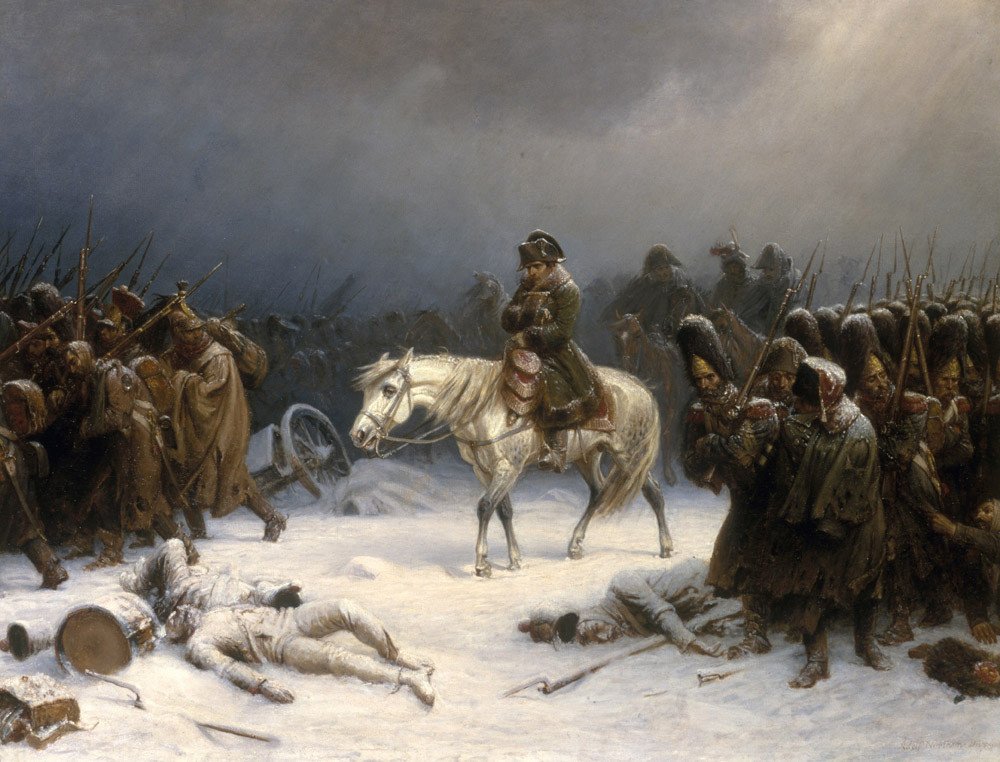
Napoleon and his Grande Armée, Retreating from Moscow

The author explains that during the cold Russian winter, the buttons on the French soldier's coats broke, opening them up to the cold.  Besides causing sickness, fighting without buttons might be difficult.
Tin button

We do know for sure that during the winter of 1812 the French Grande Army lost thousands of men and were forced to retreat.  From this point, France was never able to realize its vision of ruling over a huge empire and Russia would continue to remain free of foreign rule.
In this example of Napoleon's Army we can see that the understanding the properties of something as simple as the atoms in tin can make a huge difference in history.

Chemistry is the study of chemical elements (like tin, gold, helium, uranium, oxygen, etc.) and compounds (like water, sugar, carbon dioxide) and how matter like this changes.

One of the goals of this unit is to explore what matter is.  You will be given a chance in this unit to understand how our world works by analyzing the very small.

If the answers to many problems in our world are found in the very small, who knows where research and understanding atoms and molecules could eventually lead us?

Monday, August 22, 2016

Unit 1: Science is...

Unit Information
Unit 1 Goals and Resources [what is this?]
Unit 1 Vocabulary [what is this?]

Neil deGrasse Tyson, a famous astrophysicist, says we have been scientists since birth; and that science is in our DNA. But WHAT EXACTLY does it mean to be a scientist? What's more, WHAT IS SCIENCE? We will explore these two main ideas in this short introductory unit to Science 6 at AISB!


Thursday, June 2, 2016

Powerful Ways to Hook Your Audience

Check out Ms. Birzu's ideas for powerful ways to hook your audience. Consider using one in your presentation.

Role-Play
Perform a short skit.

Ask a few rhetorical questions
"How do you explain that this school pays a lot of money on energy bills? Have you ever thought of how much  energy is wasted in schools all over the world every year? Given how fast we run out of non-renewable resources, don’t we all deserve to save money instead of paying too much on electricity?”


Start with shocking data/statistics
“50.2% percentage of energy is wasted by the US economy every year”


Use the word “imagine”

“Please close your eyes and imagine you are walking the hallways. You are noticing empty classrooms. You’re also noticing lights that are turned on. Lots of lights. Imagine you could get involved. Now open your eyes. What about switching from using light bulbs to sensors?


Arouse curiosity
“I need to make a confession. My parents often do something at home that they are not proud of, something that in many ways I wish I will never do as an adult, but I feel I have to reveal that with you here. Several times every day, my parents leave the lights on in rooms where they don’t stay for long periods of time. And, yes, I’ve noticed teachers do the same in our school.”


Take the audience through a "what if" scenario.
“What if at the end of the month you will have more money left in your school account after paying the electricity bill? What if you could actually use that money to invest in teaching materials or...books for the library instead?”


Tell a story

“Linda is a 10-year old girl living in a poor village in Colombia. She lives with her parents and her 7 elder brothers. Linda tries hard to do her school work at home. However, it is not easy for her to work on it when parents decide to turn off the lights in the house to save energy. They can’t afford to pay the monthly bills. They use energy for 2 hours only. Two hours a day. Two hours every day. …….”

Wednesday, June 1, 2016

Presenting Data in Your Presentation

We've learned this year that adding data in the form of a chart can make a big impact on your audience.  To make that impact even stronger consider the way you describe a chart.

Our language expert, Ms. Birzu, has some great tips to help you explain data in your presentation.


Explaining a bar graph/chart/pie chart


INTRODUCTION:
This …(pie chart/bar graph etc.).... indicates/shows ….(how much/how long/how often/how many etc -use words from the chart titles)... .


FINDINGS:
You can see that …( ex: a larger proportion of teachers leave lights on../lights are on in 6th grades classrooms most of the time/most 6th graders recycle bins for plastic and paper/most hand towels are EQUALLY used to dry hands and other purposes etc .etc.).....


In contrast, ….( (here you COMPARE  the small percentages; ex: a small number of teachers turn lights off.../ less lights are turned off, which is a percentage of only 20.8%).. , whereas …(here you talk about the smallest number/percentage; ex: only 17% represent …).


However, …(here you talk about contrasting numbers/percentages)...


CONCLUSION:
As you can see, …(say a conclusion about what the survey/bar graph shows).


Overall, we can see that….(conclude by saying the purpose of your project; ex:  our school can save a lot of money if we instal sensors, etc.).


HELPFUL WORDS for describing graphs
  • UP – Verbs rise, increase, grow, go up, improve, jump, surge, shoot up , soar, rocket
  • UP – Nouns a rise, an increase, growth, an upward/rising/increasing trend, an improvement, a jump, a surge
  • DOWN – Verbs fall, decrease, drop, decline, go down, slump, plummet
  • DOWN – Nouns a fall, a decrease, a decline, a downward/falling/decreasing trend, a slump
  • NO CHANGE – Verbs remain stable/constant, stay at the same level, stabilize
  • FREQUENT CHANGE – Verb fluctuate
  • FREQUENT CHANGE – Noun – fluctuation
  • AT THE TOP – Verbs reach a peak, peak., reach its/their highest point
  • AT THE BOTTOM – Verbs reach/hit a low (point), hit/reach its/their lowest point


TO SHOW CHANGE
Adjectives:
  • dramatic, considerable, sharp, significant, moderate, slight, sudden, rapid, steady, gradual, slow
Adverbs:
  • dramatically, considerably, sharply, significantly, moderately, slightly, suddenly, rapidly, steadily, gradually, slowly
Prepositions:

  • a rise from HUF 725 to HUF 1100
  • to increase by 2.1 %
  • an increase of 2.1 % energy saving